zaterdag 22 januari 2022

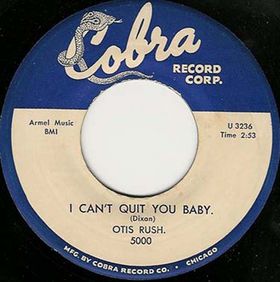
Otis Rush -"I Can't Quit You Baby"

Otis Rush Jr. (April 29, 1934 – September 29, 2018) was an American blues guitarist and singer-songwriter. His distinctive guitar style featured a slow-burning sound and long bent notes. With qualities similar to the styles of other 1950s artists Magic Sam and Buddy Guy, his sound became known as West Side Chicago blues and was an influence on many musicians, including Michael Bloomfield, Peter Green and Eric Clapton.


"I Can't Quit You Baby" is blues song written by Willie Dixon and first recorded by Chicago blues artist Otis Rush in 1956.[1] It is a slow twelve-bar blues ensemble piece, with lyrics about the consequences of an adulterous relationship which is difficult to end. 

 "I Can't Quit You Baby" was Rush's first recording and Cobra Records's debut single. It became a record chart hit as well as a blues standard. Rush updated the song in 1966 with a modified arrangement, which was adapted by Led Zeppelin for their 1969 debut album

 I can't quit you, baby
But I've got to put you down for awhile
You know I can't quit you, baby
But I've got to put you down for awhile
Well, you messed up my happy home, babe
Made me mistreat my only child


donderdag 20 januari 2022

Bob Dylan at at Frank Sinatra's 80th Birthday Party - “Restless Farewell.”

  In 1995, Dylan played at Frank Sinatra’s 80th birthday charity benefit concert, delivering a beautifully arranged version of a very old song of his containing so many lines that would have deep resonance for both Sinatra and Bob at that point (and this one): “Restless Farewell.”


"Restless Farewell" is a song by Bob Dylan, released as the final track on his third studio album The Times They Are a-Changin' in 1964. The melody is based on the Scottish folk song "The Parting Glass".


Francis Albert Sinatra ( Hoboken, New Jersey, 12 december 1915 - Los Angeles, 14 mei 1998)


dinsdag 18 januari 2022

Van Morrison-"It's All in the Game"


  "It's All in the Game" is a pop song whose most successful version was recorded by Tommy Edwards in 1958. Carl Sigman composed the lyrics in 1951 to a wordless 1911 composition titled "Melody in A Major", written by Charles G. Dawes, who was later Vice President of the United States under Calvin Coolidge. It is the only No. 1 single in the U.S. to have been co-written by a U.S. Vice President[1] or a Nobel Peace Prize laureate (Dawes was both).

The song has become a pop standard, with cover versions by dozens of artists, some of which have been minor hit singles.

Van Morrison included his version in a medley with "You Know What They're Writing About" on his 1979 album Into the Music; he also used the song as the B-side of his 1982 single "Cleaning Windows". His cover of the song was voted number 813 on Dave Marsh's list of 1001 Greatest Singles Ever Made.[ Morrison also released it on the live albums Live at the Grand Opera House Belfast (1984), A Night in San Francisco (1994) and Live at Austin City Limits Festival (2006).


maandag 17 januari 2022

Neil Young (feat.Crosby & Nash) - After The Gold Rush


"After the Gold Rush" is a song written and performed by Neil Young and is the title song from his 1970 album of the same name.In addition to After the Gold Rush, it also appears on the compilation albums Decade, and Greatest Hits, and on Live Rust.

After The Gold Rush is an environmental song... I recognize in it now this thread that goes through a lotta my songs that’s this time-travel thing... When I look out the window, the first thing that comes to my mind is the way this place looked a hundred years ago (Neil Young)


zaterdag 15 januari 2022

Big Mama Thorton (feat.Buddy Guy) - Hound Dog

   Willie Mae Thornton (December 11, 1926 – July 25, 1984), better known as Big Mama Thornton, was an American rhythm-and-blues singer and songwriter. She was the first to record Leiber and Stoller's "Hound Dog", in 1952,[2] which became her biggest hit, staying seven weeks at number one on the Billboard R&B chart in 1953[3] and selling almost two million copies.[4] Thornton's other recordings included the original version of "Ball and Chain", which she wrote(Wikipedia)


              Hound Dog

Her recording of Hound Dog, written by Jerry Leiber and Mike Stoller in 1952, and later recorded by Elvis Presley, reached Number 1 on the Rhythm & Blues Records chart. According to Maureen Mahon, a music professor at New York University, "the song is seen as an important beginning of rock-and-roll, especially in its use of the guitar as the key instrument"

donderdag 13 januari 2022

The Who - Tommy Live!! Houston 20th Nov.1975


De kick -off van hun Amerikaanse tour in 1975 ,en gelijk een van de beste optredens van deze toernee.In verband met het album van de week heb ik de Tommy set er uitgepikt.
Graag ook even aandacht voor het geweldige drummen van Keith Moon.


Amazing Journey / Sparks - Tommy's onderbewustzijn onthult zichzelf tegenover hem als een lange onbekende, gekleed in een zilverachtig gewaad met een gouden ,lange baard. Het visioen van hem lanceert hem in een spirituele reis door zijn binnenste waarin hij leert alle fysieke gevoelens als muziek te interpreteren.


Acid Queen / Tommy's ouders proberen hem maar weer eens te genezen. Dit keer wordt hij achtergelaten bij een vrouw die Tommy weer bij bewustzijn probeert te brengen door hem te bedwelmen met hallucinogene stoffen. Underture is een uitgebreide muzikale weergave van Tommy's drugs-ervaring.


Fiddle About - Tommy wordt achtergelaten bij zijn licht gestoorde alcoholistische oom Ernie. Ernie grijpt de kans om Tommy te misbruiken, zonder dat hij hoefde te vrezen dat iemand erachter zou komen. (...you won't shout as I fiddle about...)


Pinball Wizard - Men komt erachter dat Tommy een uitzonderlijk talent heeft om te flipperen en al snel verslaat hij de kampioen van het vorige toernooi. Dit leidt ertoe dat Tommy internationale faam krijgt. Pinball Wizard wordt gezongen door de voormalige kampioen. (...Even on my favourite table, he can beat my best...)


I'm Free - Tommy probeert de mensen die naar zijn preken luisteren spiritueel te verlichten.


Tommy's Holiday Camp - Tommy stelt zijn eigen huis open voor diegenen die ervoor openstaan om zich bij hem te voegen en prikkelt hen om zoveel mogelijk mensen mee te nemen als ze kunnen. Tommy opent zijn huis en dat is dan ook gauw vol met mensen, waarop hij een vakantiekamp bouwt om iedereen te kunnen herbergen.


We're Not Gonna Take It - Tommy vraagt zijn volgelingen om zichzelf (tijdelijk) te verblinden, en zichzelf doofstom te maken om werkelijk de spirituele hoogten te bereiken, maar de hardhandigheid van zijn cultus en de uitbuiting van haar volgelingen door zijn familie en aangetrouwden, zorgen ervoor dat zíjn volgelingen tegen hem in opstand komen. (...We're not gonna take it...). In de steek gelaten door zijn volgelingen en aanbidders, krijgt Tommy een nieuwe verlichting. (...See Me, Feel Me, Touch Me, Heal Me...)

woensdag 12 januari 2022

Taj Mahal - Fillmore East, February, 1971

        © Amalie R. Rothschild, 1971

 Taj Mahal- vocals, harmonica, banjo, National steel guitar, fife; John Hall- electric guitar; John Simon - piano; Howard Johnson - tuba, baritone saxophone, horn arrangements; Bob Stewart - tuba, flugelhorn, trumpet; Joeseph Daly - tuba, valve trombone; Early McIntyre - tuba, bass trombone; Bill Rich - bass; Greg Thomas - drums; Kwasi "Rocky" DziDzournu - Congas

  © Amalie R. Rothschild, 1971

"You Ain't No Streetwalker Mama, Honey But I Sure Do Love The Way You Strut Your Stuff."

 The relaxed groove continues on Taj Mahal's original "Big Kneed Girl," before the group pulls out all the stops by wrapping up the set with "You Ain't No Streetwalker Mama, Honey But I Sure Do Love The Way You Strut Your Stuff." This is the prime example of Taj and the group's dynamic control, as over the course of this extended jam, the group often plays softly and sparsely, making the louder passages even more exciting and dramatic. Everyone makes a strong contribution, but the standout musician may be pianist John Simon, who has played brilliantly throughout the set. In many ways, he is the glue that helps this unusual configuration jell so well on stage. This number also features more superb blues harp from Taj before it quietly dissolves signaling the end of the set.

     "Diving Duck Blues."

The Fillmore East audience has no intention of letting things end here and their enthusiastic response entices Taj and the group back for an encore. Just shy of being complete due to tape stock running out, this features the entire group tackling Sleepy John Estes' "Diving Duck Blues." A song originally recorded for Taj's debut album, this is an altogether more exciting performance, fueled by Johnson's great horn arrangements and standout contributions from Simon and Hall, whose piano and lead guitar work respectively, are both outstanding. . (Bershaw)


dinsdag 11 januari 2022

The music of Slim Harpo


Slim Harpo (11 januari 1924 – 31 januari 1970) was een Amerikaans bluesmuzikant.
Geboren als James Moore in Lobdell, Louisiana als oudste van de familie werkte Moore als stuwadoor en bouwvakker in de late jaren 30 en vroege jaren 40. Hij begon met optreden in bars gelegen in Baton Rouge onder de naam Harmonica Slim. Later begeleidde hij Lightnin' Slim, zijn zwager, zowel live als in de studio voordat hij aan zijn solocarrière begon in 1957. De naam Slim Harpo werd verzonnen door muziekproducent Jay Miller zijn debuutsingle I'm a King Bee en I Got Love If You Want It (b-kant), is erg beïnvloed door Jimmy Reed. Hij begon met opnemen onder het platenlabel Excello Records en maakte mooie R&B-singles gecombineerd met zijn zang en mondharmonica. Een paar van die onvergetelijke singles waren: "Rainin' In My Heart" (1961), "I Love The Life I Live", "Buzzin'" (instrumentaal) en "Little Queen Bee" (1964).

Muddy Waters (I,m a kingbee) John Primer Gitaar,Rick Kreher Gitaar,Loui Lee Piano,
George ''mojo''Bufford Harmonika,Earnest Johnson Bass,Ray''killer''Allison Drums

Harpo stond bekend om zijn mondharmonica, de naam "Slim Harpo" was een humoristisch aftreksel van "slim harp", een populaire bijnaam voor de mondharmonica die werd gebruikt in de blueswereld.


Rolling Stones (hipshake & tumbling dice)
van het album Exile on Mainstreet met Mick Taylor

Harpo's ontspannende, bijna luie optreden zette zijn stijl neer. Zijn warme en langzame stem was goed te horen op de single "I'm a King Bee", die The Rolling Stones later coverden. ZZ Top en The Rolling Stones coverden ook zijn nummer "Shake your Hips", oorspronkelijk opgenomen door Harpo in 1966.


The Cramps Strange Love

Ook de Pretty Things, de Yardbirds, The Kinks en Them hebben nummers van Harpo gecoverd. In 1966 scoorde Harpo in de "US Top 20 pop hit" een hit met het nummer "Baby Scratch My Back", wat ook een #1 R&B-hit was, en wat zijn carrière nieuw leven inblies. Harpo was geen full-time muzikant, naast bluesartiest was hij ook eigenaar van een vrachtwagenbedrijf in de jaren 60.


Pretty Things (Raining in my Heart'

Nadat de Stones "King Bee" op hun debuutalbum hadden gezet begon Slim Harpo op te treden voor een blank''rock'' publiek Hij begon op te nemen met een soort psychedelic sound en trad op in the Electric Circus en the Fillmore East in 1969.


Lou Ann Burton

Een Europese toernee lag in het verschiet,met mogenlijk commercieel succes.
Hij mocht het niet meer meemaken, op 31 Januarie 1970 overleed Slim Harpo aan een hartaanval.
Hij heeft mooie muziek achtergelaten.


Slim Harpo - Baby Scratch My Back

Slim Harpo 11-01-1924 - 31-01-1970

vrijdag 7 januari 2022

Gerry & The Pacemakers


               The band in 1964:Les Maguire-Gerry Mardsen-Freddy Mardsen-Chad Chadwick

Gerry and the Pacemakers were a British beat group prominent in the 1960s Merseybeat scene. In common with The Beatles, they came from Liverpool, were managed by Brian Epstein, and were recorded by George Martin.[1] Their early successes alongside the Beatles were instrumental in popularizing the Merseybeat sound and launching the wider British beat boom of the mid-1960s.

              "Ferry Cross the Mersey"


 "Ferry Cross the Mersey" is a song written by Gerry Marsden. It was first recorded by his band Gerry and the Pacemakers and released in late 1964 in the UK and in 1965 in the United States. It was a hit on both sides of the Atlantic, reaching number six in the United States[2] and number eight in the UK.[3] The song is from the film of the same name and was released on its soundtrack album. In the mid-1990s, a musical theatre production, also titled Ferry Cross the Mersey, related Gerry Marsden's Merseybeat days; it premiered in Liverpool and played in the UK, Australia, and Canada


Gerry Marsden announced his retirement on 29 November 2018, in order to spend more time with family, but, on 6 June 2019, to commemorate Liverpool's win against Tottenham in the Champions League, he surprised Take That fans by singing "You'll Never Walk Alone" at their show at Anfield.

Original bass player Les Chadwick died on 26 December 2019.

Gerry Marsden died on 3 January 2021.


dinsdag 4 januari 2022

Muddy Waters - Jazz Festival Copenhagen (27 Oktober 1968)

 The band with  Otis Spann -piano/vocals, Paul Oscher - harmonica,Luther Johnson and Pee Wee Madison -guitars,Sonny Wimberly - bass,SP Leary - drums.

 Setlist:
Back At The Chicken Shack
Train Fare Blues
(I’m Your) Hoochie Coochie Man
Long Distance Call
Nobody Knows My Trouble
Cold Cold Feeling
Got My Mojo Working
Tiger In Your Tank